

When NVIDIA does something, the world pays attention. And what they’ve just done with NemoClaw is basically take OpenClaw — the open source AI agent you already know if you follow me — and turn it into something an IT director at a large company can approve without their hands shaking.
NemoClaw is not a new product built from scratch. It’s OpenClaw with corporate steroids. Enterprise security, privacy controls, audit tools. Everything companies need to be able to say “yes, we can use AI agents” without the legal department throwing a fit.
Let’s see what it brings and why it matters.
What is NemoClaw and why NVIDIA created it
OpenClaw is fantastic. I use it every day. But it has a problem when we talk about companies: it has no enterprise security controls. No granular permission system. No audit logs. No Privacy Router.
And for a company handling customer data, financial information, or intellectual property, that’s a showstopper. You can’t deploy an AI agent that has access to everything and leaves no trace of what it does. Well, technically you can, but your CISO will have your head.
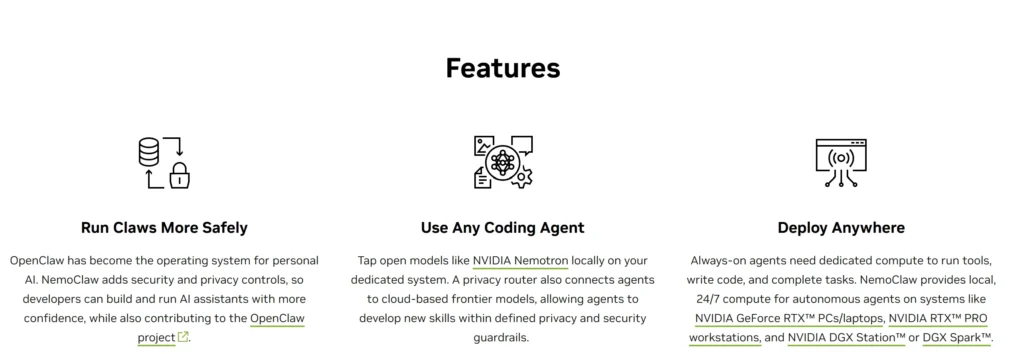
NemoClaw fixes exactly this. NVIDIA took the OpenClaw core and added a layer of security, privacy, and governance that makes it fit for corporate environments. It’s like the difference between Linux and Red Hat Enterprise Linux. The engine is the same, but one comes with support, certifications, and guarantees that businesses need.
NemoClaw features that set it apart from OpenClaw
It’s not just “OpenClaw with an NVIDIA logo.” There are new components that don’t exist in the open source version.
OpenShell: the secure sandbox for agents
This is probably the most important NemoClaw feature. OpenShell is an isolated execution environment where the agent can do its work without having direct access to the system. Think of it as a glass room: the agent can work inside, but can’t get out or touch anything outside.
In regular OpenClaw, when the agent runs code, it does so directly on your system. If you ask it to delete temporary files and it gets the wrong folder… well, you know. With OpenShell, everything runs in an isolated container. If something goes wrong, the damage stays contained.
For a company, this is the difference between “we can try AI agents” and “no way.”
Privacy Router: total control over your data
NemoClaw’s Privacy Router is an intelligent intermediary that sits between the agent and the AI models. Before any data goes out to an external API, the Privacy Router analyzes it and can:
- Detect and mask personal information (names, emails, phone numbers)
- Block sensitive data from being sent to external models
- Redirect queries with sensitive data to local models instead of cloud APIs
- Log everything for audit purposes
Imagine an employee asks the agent: “Analyze this contract with client John Smith, email john@company.com, worth 2.3 million.” Without a Privacy Router, all that information goes straight to OpenAI’s or Anthropic‘s API. With Privacy Router, personal data gets masked before leaving, or the query is processed on a local model entirely.
For European companies dealing with GDPR, this isn’t a nice-to-have. It’s mandatory.
Granular permission system
In OpenClaw, the agent can do basically everything you can do on your computer. NemoClaw introduces a permission system where you can define exactly what each agent can and cannot do:
- Which files it can read
- Which commands it can execute
- Which APIs it can call
- How many tokens it can consume per session
- Which users can access which agents
It’s like handing out office keys. Not everyone gets the key to every room. Each person (or agent) only has access to what they need.
Complete audit logs
Everything an agent does in NemoClaw gets logged. Every command executed, every file read, every API call, every decision made. With timestamps, the user who launched it, and the result.
Why does this matter? Because when the regulator knocks on your door and asks “what exactly did this AI system do with our clients’ data?”, you need to answer with precision. Not with an “well, I think…”

NemoClaw vs OpenClaw: when to use each one
It’s not that one is better than the other. They’re for different use cases. For a broader comparison of OpenClaw against other AI tools, see my OpenClaw vs ChatGPT vs Claude breakdown.
OpenClaw is perfect for:
- Individual developers and small teams
- Personal projects and startups
- Experimentation and rapid prototyping
- When you’re not handling sensitive third-party data
I use OpenClaw for everything. To manage Copito (the agent for Good Old Clean, my cleaning company in London), to automate tasks for my web projects, to generate content. I don’t need NemoClaw because I’m a one-person team and the data I handle is my own.
NemoClaw is for:
- Medium and large companies with compliance requirements
- Regulated sectors: banking, healthcare, legal, government
- Teams that need role-based access control
- Any organization handling client data or confidential information
If you’re a bank and want an AI agent to analyze contracts, NemoClaw. If you’re a hospital and want an agent to process medical records, NemoClaw. If you’re a freelancer who wants to automate their email, OpenClaw is more than enough.
The elephant in the room: is it really open source?
There are nuances here. NemoClaw has open source components and proprietary components. The OpenClaw core remains open source. But the enterprise layers — OpenShell, Privacy Router, the advanced permission system — are proprietary to NVIDIA.
Is this bad? Depends on how you look at it. Red Hat did the same thing with Linux and nobody complains (well, some do, but they did pretty well). The community version still exists, is still free, and keeps improving. The enterprise version adds things companies are willing to pay for.
The important thing is that OpenClaw isn’t going to disappear or stop being open source because NVIDIA released NemoClaw. They’re two complementary products, not competitors.
What this means for the AI agent ecosystem
NVIDIA entering the AI agent game with NemoClaw is a massive signal. We’re not talking about a three-person startup. We’re talking about a company valued at 3 trillion dollars saying: “AI agents are the future and we’re going to invest seriously.”
This validates the entire ecosystem. AI agents aren’t a toy, they’re not an experiment. They’re serious enterprise infrastructure. And when NVIDIA treats them as such, CIOs around the world start paying attention.
For those of us who’ve been in this for a while, it’s good news. More investment means better tools, more documentation, more stability. For those who haven’t gotten on the train yet, NemoClaw might be the push they needed. Because one thing is some bald guy in Dubai telling them AI agents work. Another thing is NVIDIA saying it.
My honest opinion on NemoClaw
I don’t need it. And you probably don’t either if you’re reading this blog. My audience is entrepreneurs, developers, people who build things. For us, OpenClaw is more than enough.
But I’m glad NemoClaw exists. Because every time a big company adopts AI agents, it normalizes the technology. And when technology gets normalized, more opportunities appear for everyone. More clients who want agents. More companies that need someone to set them up. More market for those of us who know how to do this.
The Privacy Router is brilliant. Truly. The fact that an agent can process sensitive data without that data leaving the premises is something that should exist in every AI implementation. I hope something similar eventually makes it to the open source version.
OpenShell is also a win. Isolated execution should be the standard, not an enterprise extra. But I understand NVIDIA needs to monetize, and these are the features companies pay for.
Bottom line: NemoClaw is OpenClaw for companies that need to comply with regulations and sleep well at night. If that’s you, check it out. If not, stick with OpenClaw and enjoy the power without the corporate restrictions.
And if you want to learn how to set up your own agent with OpenClaw, that’s something I can definitely teach you. If you prefer a visual interface for OpenClaw, check out ClawX.
See you in the next one.